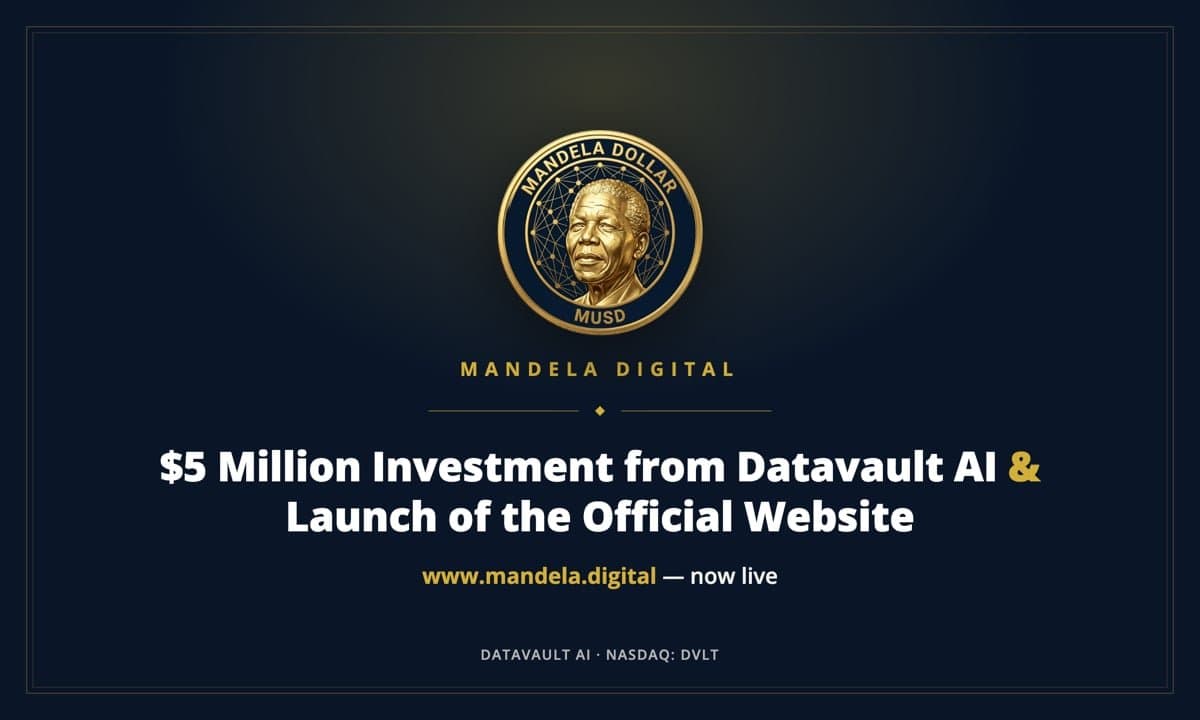
Mandela Digital has secured a $5 million investment from Datavault AI Inc. (NASDAQ: DVLT), with funds already being deployed to accelerate the launch of the Mandela Dollar (MUSD), a 1:1 USD-backed stablecoin targeting the unbanked and underbanked populations across the Global South. The company simultaneously went live with its official hub at www.mandela.digital.
What Datavault AI Brings to the Table
Beyond the capital commitment, Datavault AI is stepping in as the primary technology partner, contributing its patented AI platforms, blockchain tokenization frameworks, and SanQtum quantum-resilient encryption. That last piece matters: quantum-secure infrastructure is still rare in stablecoin issuance, and its inclusion signals the project is building with a longer runway in mind. The tech stack will cover MUSD issuance, redemption processing, on-chain compliance monitoring, and real-world asset (RWA) integration.
The $5 million is earmarked across several workstreams: stablecoin infrastructure build-out, regulatory compliance filings, exchange integrations, liquidity provisioning, and go-to-market execution. No single-line budget breakdown was disclosed, but the scope suggests a heavy early weighting toward compliance, given the cross-border remittance use case MUSD is designed to serve. The regulatory environment around stablecoins has grown considerably more complex in 2025 and 2026, making that prioritization practical.
The 67-Day Early Access Window
Mandela Digital opened the Application Stage of its Early Access Programme on Nelson Mandela International Day 2026. The window runs for exactly 67 days, a deliberate reference to the 67 years Nelson Mandela spent in the struggle for human rights, equality, and social justice. The programme gives early participants access to MUSD ahead of a broader public launch; specific allocation terms were not disclosed at this stage.
The project frames itself around what it calls «institutional-grade financial infrastructure» paired with the moral weight of the Mandela name, positioning MUSD as a remittance and digital payments tool for populations that traditional banking has historically underserved. Whether the stablecoin can carve meaningful volume in a segment already contested by established players, including Tether's USDT, remains an open question. For context on how competitive stablecoin positioning plays out in practice, the broader trend of institutional capital flowing into crypto-native payment rails has been accelerating through 2026.
DVLT shares had not registered a notable move on public markets at the time of the announcement.
This article is for informational purposes only and does not constitute financial advice. Cryptocurrency investments carry significant risk; always conduct your own research before committing capital.