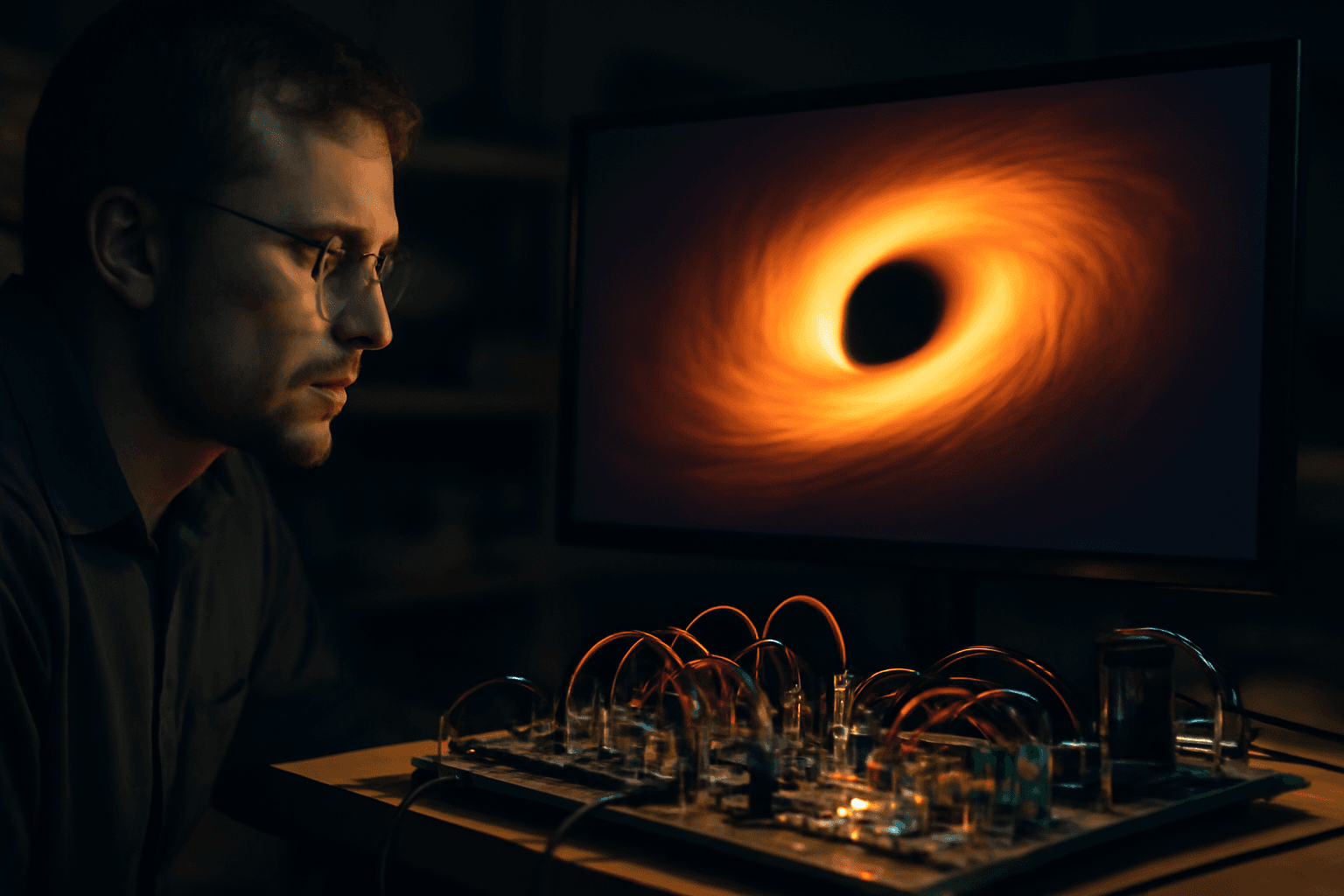
"It's like conjuring the spin of a black hole on your lab table," remarked one physicist involved in the project at CUNY's Advanced Science Research Center. Without any moving parts, their ring-shaped array of electronic resonators managed to mimic the way rotating black holes leak energy, producing a measurable 7.8 dB gain by cleverly modulating electromagnetic waves.
This groundbreaking demonstration, published July 8, 2026, in Nature as “Observation of Floquet rotational super-radiance,” revives a theory from 1969 that predicted the extraction of energy from rotating objects, known as superradiance. Traditionally, this phenomenon required physically spinning cylinders or vortices, but the CUNY team replaced rotation with rapid modulation, creating an illusion of ultrafast spin that coaxed energy from electromagnetic waves.
The researchers employed a stationary circuit composed of interconnected resonators arranged in a ring, with electronic properties modulated in a precise sequence to simulate the effects of rotation. This synthetic rotation trick allowed the stationary setup to amplify waves, a development that could pave the way for new broadband amplification methods in quantum and wave technologies. Andrea Alù, a leading scientist on the project, highlighted how support from the Department of Defense and NSF is enabling innovations extending synthetic wave manipulation beyond current limits.
While the tech world is often focused on chips and AI, this work reminds us that profound advances can come from fundamental physics experiments. By translating an astrophysical concept into tabletop electronics, the team has opened doors for exploring wave amplification in compact, practical platforms. The implications might stretch across fields, potentially influencing developments in communication systems, quantum computing, and advanced sensing technologies.