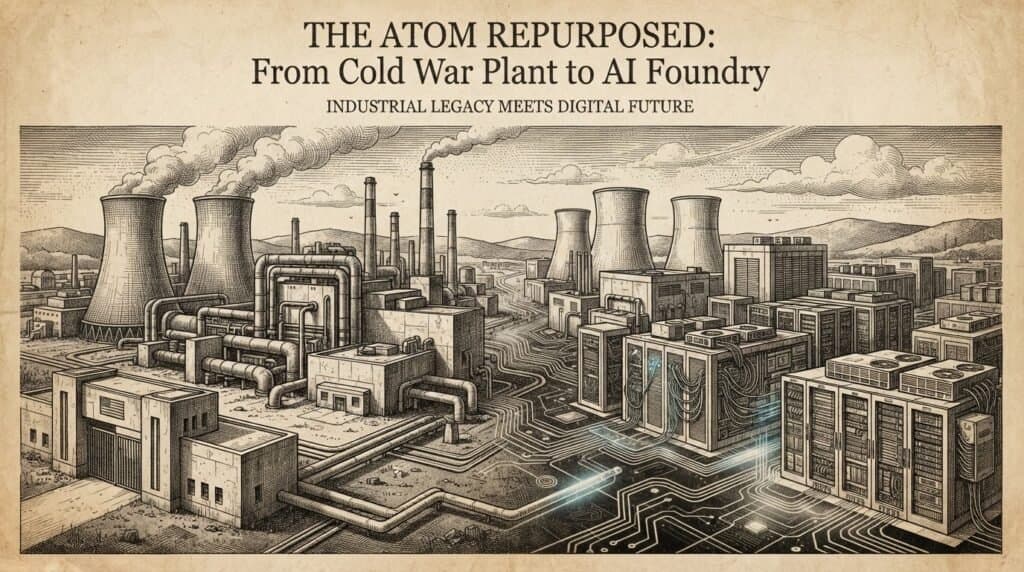
The Department of Energy is turning a former Cold War uranium enrichment site in Kentucky into a $100 billion AI data center complex. This move ends the scramble among AI developers for private land and introduces a new model of federal land use for tech infrastructure. The Paducah American Energy Hub sits on 3,556 acres once dedicated to nuclear materials production, now repurposed to meet the massive compute demands of artificial intelligence.
Federal Land Meets Private Capital
Rather than competing for scarce private real estate, major developers like Brookfield and NextEra Energy lease land directly from the DOE. This sovereign-land approach creates a state-to-private partnership where the government provides the foundational asset, while private investors handle development and operation. It’s a sharp departure from typical private-sector projects that grapple with land acquisition and zoning hurdles.
The project is fully privately funded, with no federal money involved. NextEra Energy will build 4.6 gigawatts of dedicated power infrastructure on site, combining 2 gigawatts of natural gas generation with 2.6 gigawatts of battery storage. This aligns with the 2026 Ratepayer Protection Pledge requiring hyperscalers to cover power infrastructure costs, avoiding extra charges for residential and small-business electricity users. This arrangement aims to clear the bottlenecks that have hampered other large-scale data centers by sidestepping grid capacity issues.
A New Benchmark in AI Infrastructure
Compared to other AI compute projects, Paducah stands out for its scale and design. OpenAI’s $20 billion Project Camellia operates on private land, while the $40 billion AIP/Aligned initiative depends on acquiring private property despite sovereign backing. The massive Nvidia/OpenAI Ohio project, with a $250 billion guarantee, struggles with state-level power infrastructure challenges. Paducah’s model removes these obstacles at the outset by leveraging existing federal assets and committing private investment to infrastructure.
This pivot from military to technological use of federal land marks a significant shift in national infrastructure strategy. It may set a precedent for future AI hubs and large-scale data projects seeking stable and expansive physical footprints without the delays tied to private land deals.
This article is for informational purposes and does not constitute financial advice.