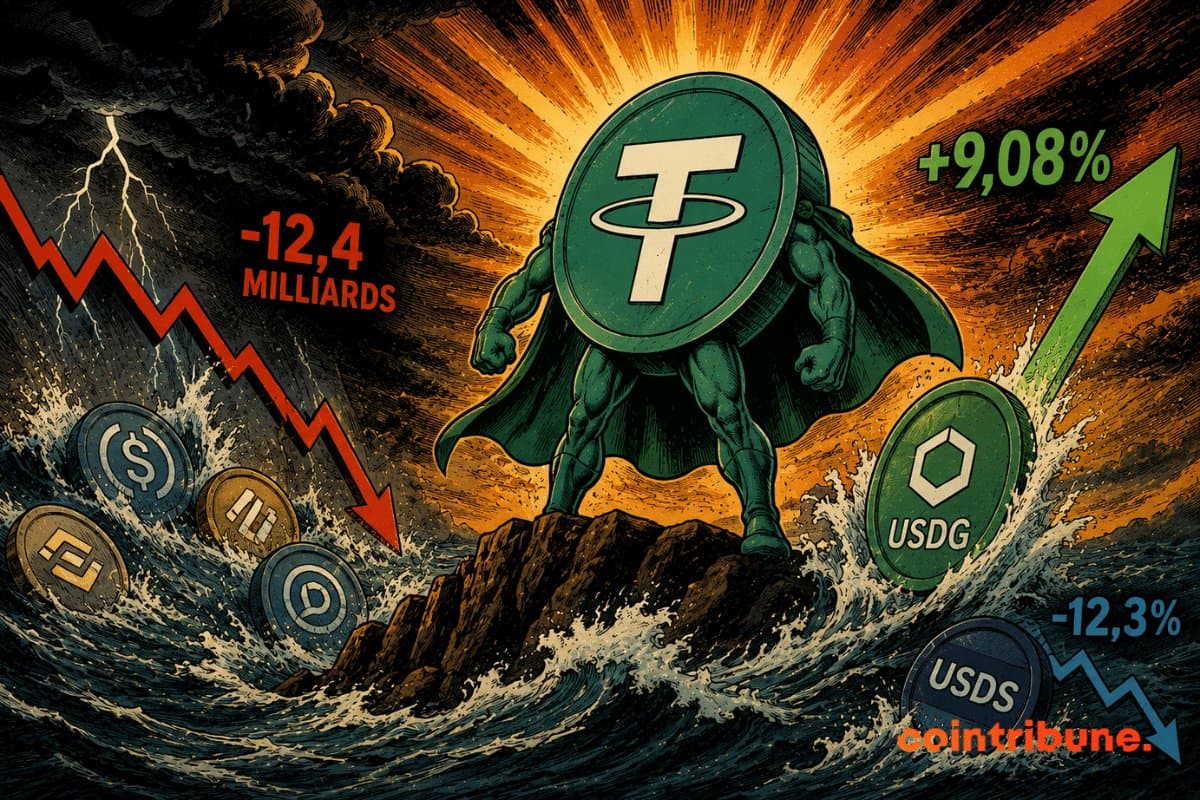
Since mid-May 2026, stablecoins have experienced a $12.4 billion withdrawal, marking the steepest market contraction since 2022. Despite this, Tether (USDT) and Circle's USDC have remained largely stable, together controlling 82% of the stablecoin sector.
Market Shifts and Diverging Trends Among Stablecoins
The overall stablecoin market cap dropped to approximately $311 billion, declining 0.61% over the past week. This movement has occurred without significant volatility in Bitcoin or major altcoins, suggesting factors beyond broad market fear are driving changes. Analysts note a structural transition: stablecoins now face competition based on yield and utility, rather than purely serving as digital dollar equivalents.
Tether holds $184.055 billion with only a 0.06% weekly decrease, and USDC follows at $73.376 billion, down 0.04%. In contrast, challengers like Sky Dollar (USDS) plunged 12.3%, falling below $7 billion, while World Liberty Financial (USD1) and BlackRock BUIDL declined by 4.59% and 8.68%, respectively. Meanwhile, Global Dollar (USDG) surged 9.08% to $3.164 billion, and PayPal's PYUSD grew 1.6% to $2.877 billion.
These contrasting performances underline a market divide: stablecoins offering yields are attracting capital, while those strictly maintaining stability lose market share. The stablecoin landscape is evolving towards prioritizing returns and additional features.
Industry Players Accelerate Adoption
In practical advancements, Hyundai completed international stablecoin transfers using Avalanche technology in just 7 minutes, compared to traditional methods taking up to 4 hours. Payment giant Visa projects that stablecoins will dominate micro-payments within AI-driven economies, signaling growing institutional interest in these assets.
According to market observers, this is not a panic-driven sell-off but a reallocation of capital shaped by innovation and shifting user demand.
This article is for informational purposes and does not constitute financial advice.