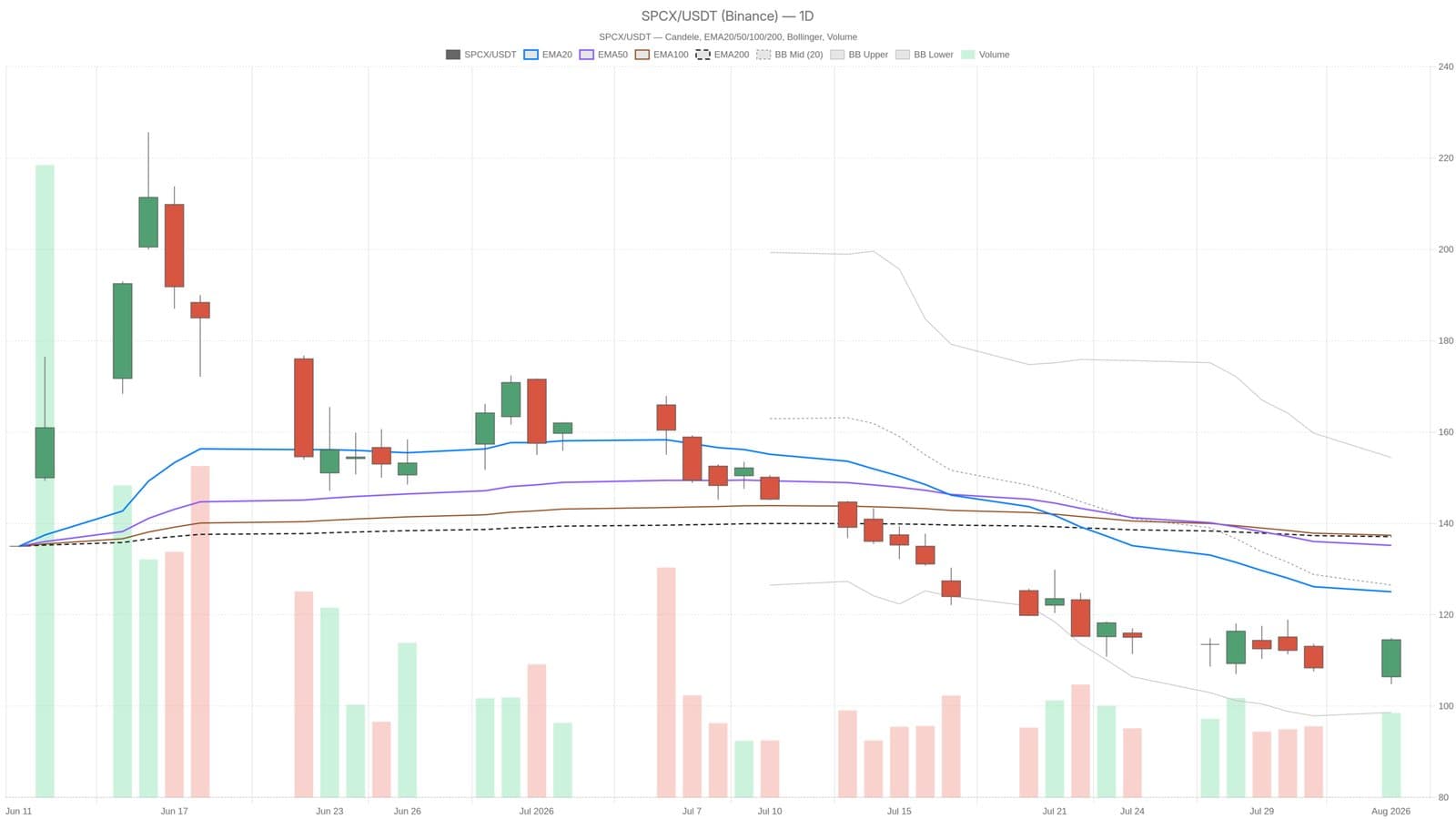
Space Exploration Technologies shares jumped nearly $10 on August 3, recovering from an intraday dip to $104.83 and closing at $114.53. On the surface, it looks like a solid reversal. The problem: price is still underwater relative to where it needs to be, and the technical setup screams caution heading into earnings.
Right now SPCX trades below all three major moving averages. The 20-day sits at $125.04, the 50-day at $135.20, and the 200-day at $137.10. That's a lot of overhead resistance. The daily MACD hasn't flipped bullish either, hovering at -10.22 with a histogram of -1. The RSI14 is at 42.96, still below the neutral 50 line. These aren't the fingerprints of a confirmed reversal, just a countertrend bounce inside what remains a bearish structure.
Hourly momentum turns, but overbought signals flash
Where things get interesting is on the hourly timeframe. A bullish MACD crossover has triggered, suggesting intraday momentum has shifted. That's real. But the 15-minute RSI is already at 74.23, deep in overbought territory. Traders chasing this bounce are running out of room to push higher without a pullback first.
Bollinger Bands paint a picture of stress. The mid-band is at $126.52, with the upper band at $154.41 and lower at $98.62. Price action hugging the lower half of the range typically signals weakness, not strength. The stock would need to break decisively above $125 just to kiss the 20-day average.
Event risk and positioning ahead of earnings
What makes this setup dangerous is the backdrop. Short interest remains elevated, and options traders are loaded up on calls, particularly around the $330 strike. Earnings could trigger sharp, violent moves in either direction, and with the daily structure still bearish and hourly momentum overbought, the risk/reward for chasing this bounce looks asymmetrical. A pullback to retest support near $104 wouldn't be shocking if earnings disappoint or if the broader market rolls over.
This analysis is informational and does not constitute financial advice. Always conduct your own research and consult a financial advisor before making investment decisions.