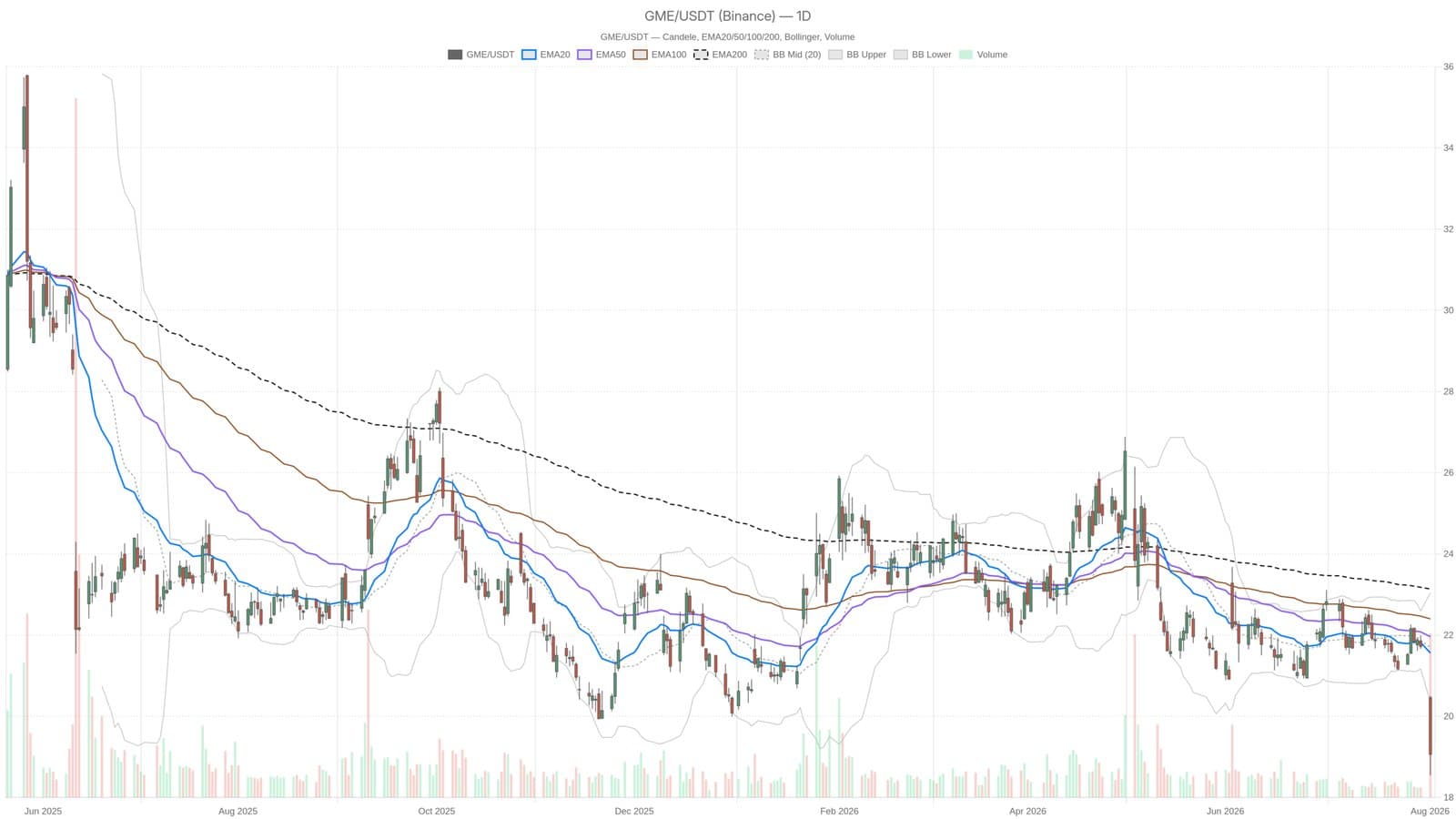
GameStop shares dropped to $19.06 on August 4, marking the lowest close since August 2024. The plunge came straight after the company announced a $1.4 billion convertible note exchange tied to Class A shares. Trading volume exploded past 40 million shares, a clear sign the market was repricing, not just drifting.
The numbers tell the story. Price sits now below all three major moving averages. EMA20 is at 21.56, EMA50 at 21.96, and the 200-day line at 23.14. That stacked order above spot price is textbook bearish setup. RSI14 has collapsed to 27.16, deep into oversold. MACD remains weak at -0.29, still below its signal line at -0.13, with the histogram at -0.16 showing downside momentum building rather than fading.
Technical picture screams stretched
Volatility expanded meaningfully. Daily ATR14 stands at 0.61. Price has broken through the lower Bollinger Band at 20.35, with the close well beneath it. When a stock closes outside the lower band after a debt-driven selloff, that typically signals an emotional move, not an orderly trend. The market overshot.
That oversold depth matters though. Mechanical bounces off these levels happen regularly. For GME, the daily pivot is 19.37, with key support at 18.24 and resistance at 20.19. Watch those levels for near-term reaction.
The convertible swap itself is what sparked the selloff. Swapping debt for equity means existing shareholders face potential dilution if those notes convert into new shares. Debt-for-equity trades always hit the stock hard in the short term, especially when volume confirms it is a genuine repricing, not just algorithmic noise.
This article is informational only and does not constitute financial advice. Always conduct your own research before making investment decisions.