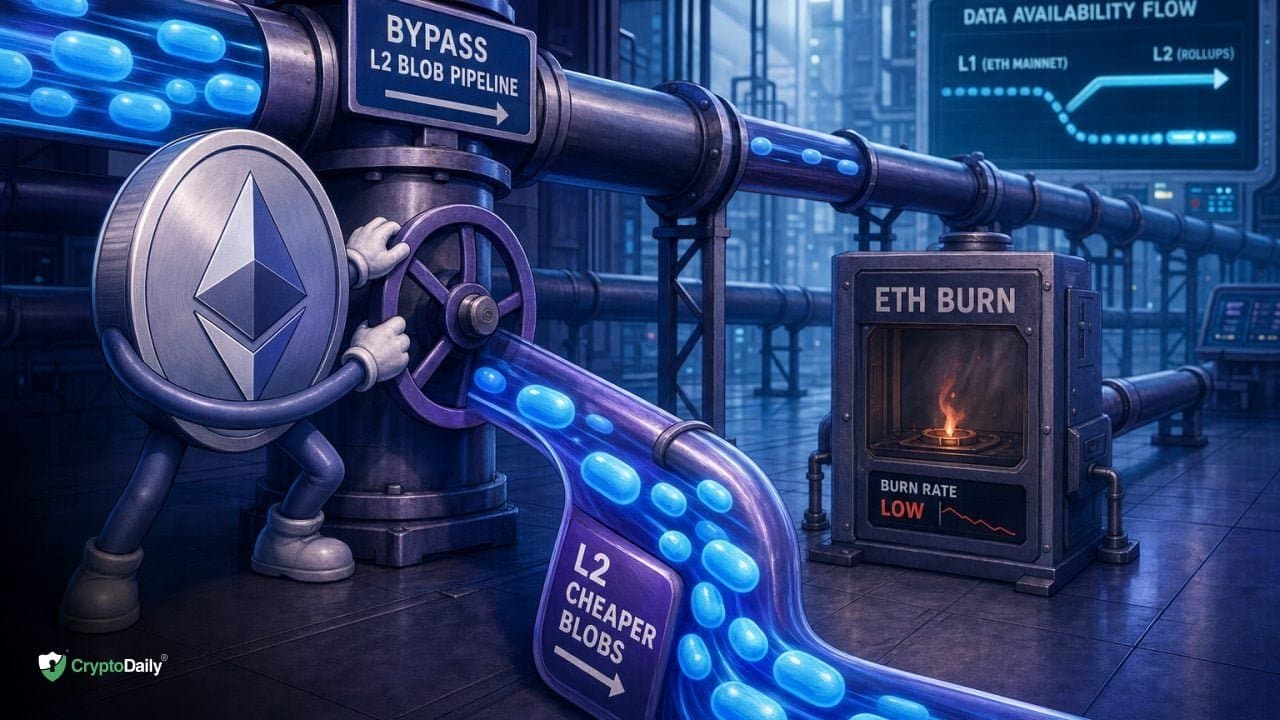
Ethereum's introduction of blobs under EIP-4844 created a new fee market that affects ETH burn rates in unexpected ways. Although Layer 2 rollup activity has increased, the expected surge in ETH burn has not materialized.
Blob Fee Market and ETH Burn
Blobs are temporary data spaces that rollups post on Ethereum to facilitate transaction verification off-chain. EIP-4844 separated blob data fees from the regular execution gas fees, resulting in cheaper rollup transactions as they no longer compete with swaps or NFT minting within the same fee market. The blob base fee, which fluctuates with demand, is burned by the Ethereum protocol when paid.
However, as reported by CryptosEyes, the burn rate depends heavily on blob space scarcity. When blob capacity is abundant or when Layer 2 solutions compress data efficiently, the blob base fee remains low, resulting in modest ETH burn despite increased usage.
Ethereum’s mainnet also continues to burn ETH from Layer 1 gas fees, but with more activity shifting to Layer 2, the L1 fee environment has become comparatively light. Data from DefiLlama indicates daily Ethereum mainnet fees around $227,000 and chain revenue near $55,700 as of July 2026.
According to ultrasound.money, the ETH supply hovered at approximately 121.88 million tokens mid-July 2026, reflecting the balance of issuance and burning across both the Layer 1 and blob fee lanes.
Major Layer 2 networks dominate demand in this new fee structure. Defi-Intel data shows the total value secured (TVS) by rollups reached about $35 billion in mid-July 2026, with Base at nearly $11 billion and Arbitrum around $10.4 billion after adjustments.
While the blob base fee burn adds a new layer to ETH supply dynamics, the overall impact on burn is tempered by how much blob space is used and how data is compressed. This nuance prevents the ETH burn from scaling linearly with Layer 2 activity growth.