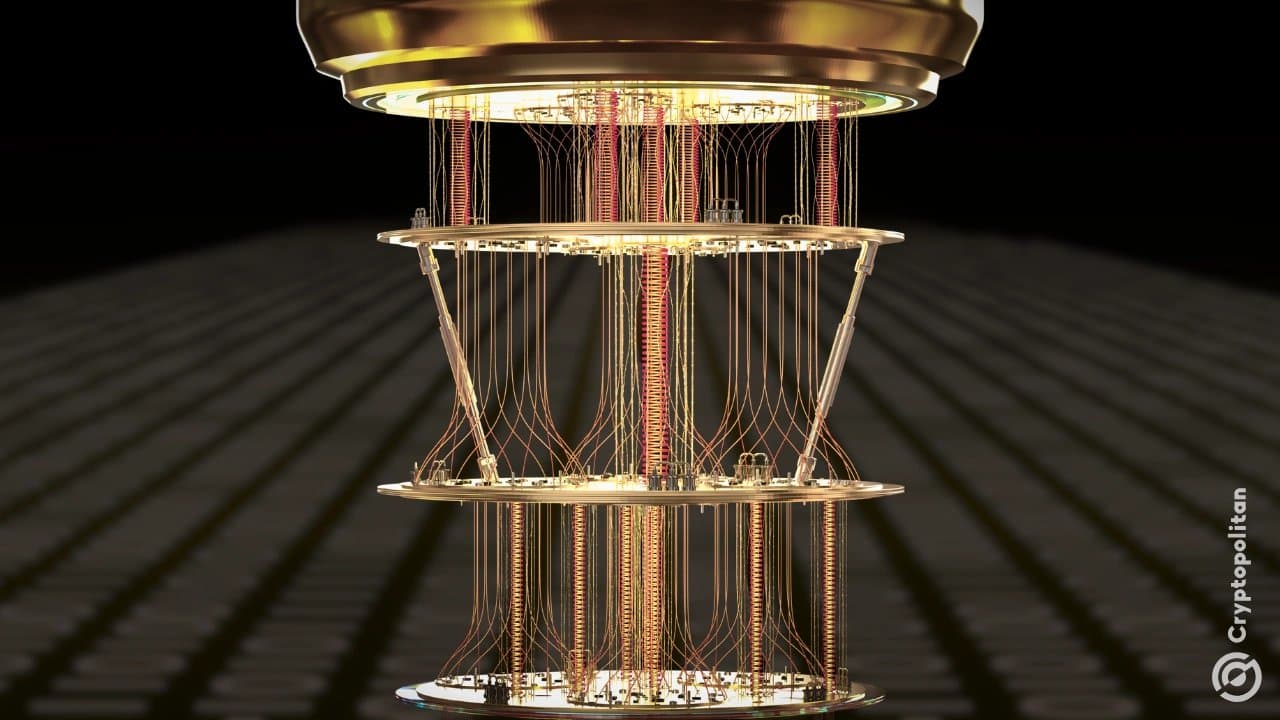
Aalto University scientists have built a quantum heat engine operating near absolute zero, marking a significant step toward more efficient, larger-scale quantum computers. The engine, contained within a superconducting circuit smaller than a grain of sand, completes a full quantum Otto cycle using a single qubit as its working substance.
Quantum Heat Engine Mechanics
The device employs a flux-tunable transmon qubit linked to a resonator and a quantum circuit refrigerator to perform thermal energy conversion at microscopic scale. This quantum heat engine mimics the operation of classical engines by transferring energy between warm and cold environments but does so within the domain of quantum physics.
Instead of relying on separate heat sources, the refrigerator alternates its settings to heat the qubit during one phase and cool it during another. By carefully adjusting the qubit's energy levels, the team completed all four stages of the quantum Otto cycle, analogous to the compression and expansion phases in traditional gasoline engines but without compressed gas.
Implications for Quantum Computing
The transmon qubit, commonly used in superconducting quantum computers, replaces the gas in this engine, enabling microwave signal control to hold and process quantum information. The breakthrough demonstrates the feasibility of executing complete quantum thermodynamic cycles on a microscopic chip, which could lead to enhanced performance and scalability of quantum processors.
Academy Professor Mikko Möttönen led the research team, which published their findings in Nature Communications. The innovation bridges concepts from classical thermodynamics and quantum computation, paving the way for practical advancements in the field.
This article is informational and does not constitute financial advice.