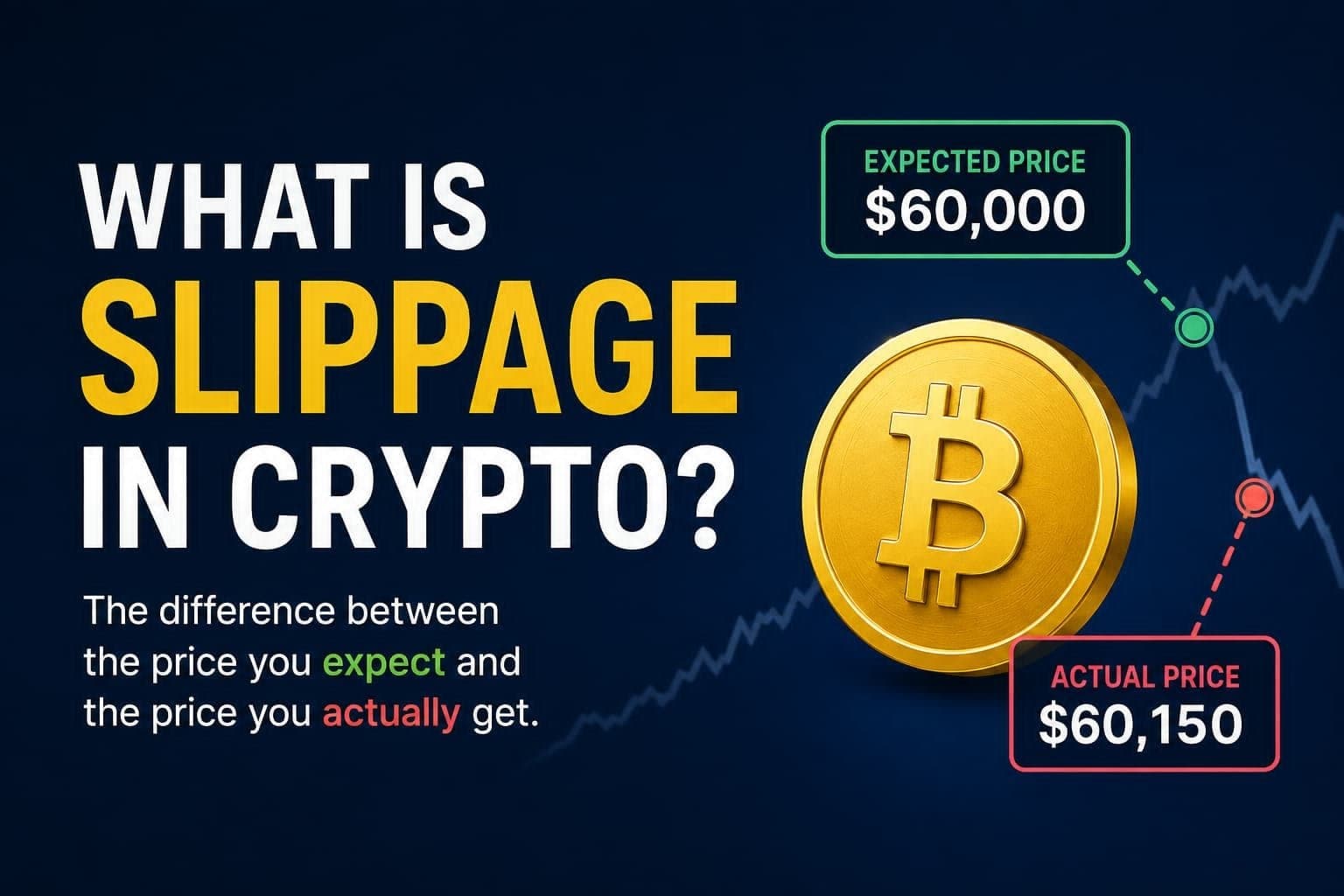
You hit buy on Bitcoin at $60,000. The order settles at $60,150. That $150 gap, the difference between what you expected and what you actually paid, is slippage. It is not a fee. Nobody is charging it on purpose. It just happens when the market moves in those few seconds between clicking and confirming.
Slippage is not new. It shows up in stocks, forex, futures, anywhere prices move fast and orders fill against live supply. In forex markets it spikes around economic data releases when currency pairs jump. But crypto makes it more visible. The market runs 24/7, prices swing harder than traditional assets, and liquidity on smaller coins can vanish. Beginners usually notice slippage right after a trade fills worse than expected.
What actually causes it
Two forces drive almost all slippage: how much liquidity sits in the order book, and how fast the price is moving. Everything else branches from those two.
When you place a market order, it fills against whatever is available, starting at the best price and working outward. Say you want to buy 12 Bitcoin and only 5 BTC sits at $60,000. Your order climbs to the next level at $60,150 for the next 5, then $60,400 for the final 5. Your average price drifts from the quote you saw. You end up paying around $60,183 per coin instead of the $60,000 you expected.
That is order book depth. The second factor is speed. A market moving 2% in sixty seconds creates more slippage than one moving 2% over an hour. Price momentum pulls quotes away faster than your order can fill. During a flash crash or a sudden pump, your market order might execute across a much wider range than the static order book suggests.
Larger orders create their own problem. A 100 Bitcoin market buy on a thin altcoin can move the entire book. You are not just filling against existing orders, you are moving the price as you trade. The bigger you are relative to the liquidity available, the worse your slippage gets.
How to keep it manageable
Limit orders let you set a ceiling on what you will pay. Instead of a market order that takes whatever fills, you specify a price and wait. You might miss the fill, but you avoid surprise slippage. Most exchanges let you set slippage tolerance on swaps, usually a percentage buffer above the quoted price. Setting it to 0.5% means your order cancels if the price moves more than that before filling. Too tight and you get failed orders. Too loose and you eat unnecessary slippage.
Liquidity matters more than you think. Trading on exchanges with deep order books, or on liquid pairs like Bitcoin and Ethereum, reduces slippage dramatically. Smaller coins and less popular trading pairs have thin books. Your order moves the price more because there is less supply to absorb it.
Timing helps too. Slippage is lowest during peak trading hours when the most volume flows through. Trading during quiet periods, especially on weekends or during low-volume windows, means your order fills against a shallower book.
This is informational material only, not financial advice. Always verify slippage terms on your exchange and consider your risk tolerance before trading.