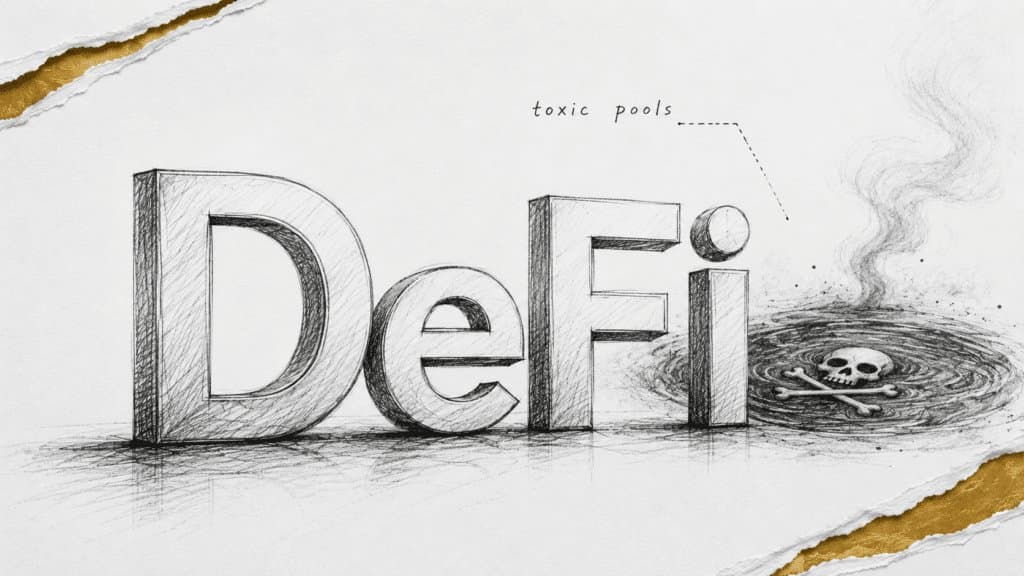
Recent findings by Enso indicate that certain DeFi liquidity pools manipulate trade simulations to mislead users, potentially causing significant financial losses.
Mechanics of Manipulation
According to Enso, a firm specializing in on-chain development, some liquidity pools are designed to project appealing prices during trade simulations, only to execute transactions at much worse rates. This manipulation, referred to as 'toxic pools,' exploits the way wallets and routing software determine the best price for trades. The toxicity lies in deceiving the simulation stage, allowing these pools to appear favorable initially.
For example, Enso documented a Curve pool on Ethereum that processed over 129,000 swaps at rates that were significantly worse than those quoted, resulting in an overstatement of approximately $225,000 in quotes and nearly $30,000 spent on failed transactions. Another instance involved a Uniswap v4 hook on Polygon that reverted 99.1% of transactions, luring routers before ultimately failing. The total profit realized by the attackers across both pools was estimated at $34,600.
Industry Implications
The findings highlight a pressing issue in the DeFi space, as the integrity of transaction executions comes into question. Milos Costantini, Enso's co-founder, emphasized the need for improved verification methods to ensure that what users receive aligns with initial simulations. The problematic pools have since been disabled, yet Enso warns that similar schemes could resurface as the same operators may deploy other contracts.
In response to these challenges, Enso has introduced Enso Shield, a tool designed to detect such fraudulent activities. The company aims to frame this issue as a broader industry concern, advocating for independent validation processes to safeguard traders. Enso has worked with entities like Curve and Oku to address these challenges.
This material is informational and not financial advice.