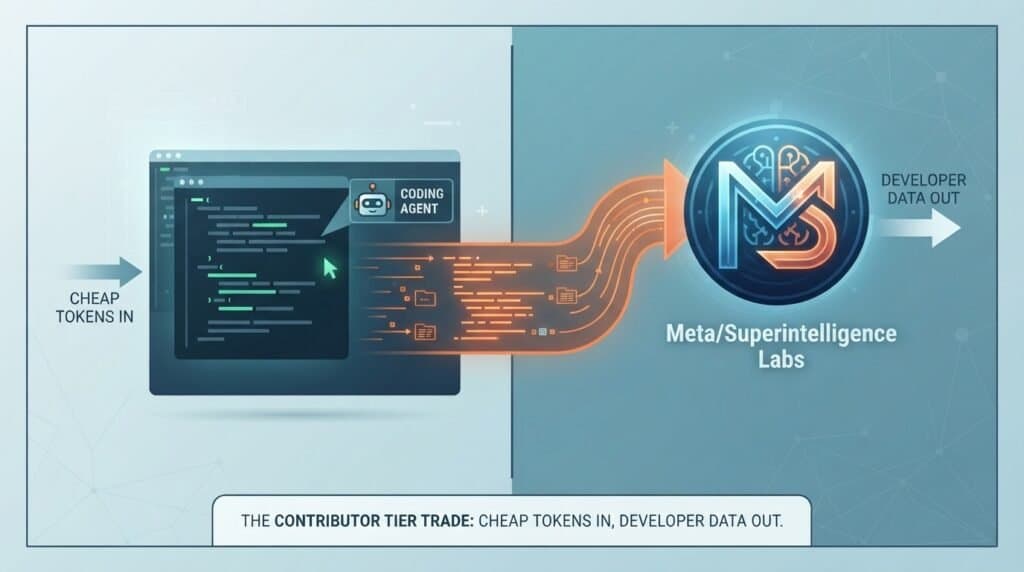
Meta Superintelligence Labs shipped its first commercial product on August 5. Muse Code, a terminal-based coding agent, installs on macOS and Linux in a single command. The move signals something larger: Meta is now copying Google DeepMind's playbook, splitting research from product teams and putting a revenue mandate on the product side.
The agent itself runs on Muse Spark 1.2, the model that came out of Meta's roughly $14.3 billion acquisition of Scale AI and the engineering team Alexandr Wang built around it. It handles long-horizon tasks across large repositories. According to Wang in a CNBC interview, the tool "can take on complete software engineering tasks across a wide variety of use cases, planning changes, writing code, validating the results." The architecture uses persistent asynchronous agents that work in parallel, with a local event log recording every model call and edit to ensure restart-safe execution.
On Meta's published benchmarks, Muse Spark 1.2 scores 82.9% on Terminal-Bench 2.1 and 59.3% on DeepSWE 1.1. That's a 6.7-point and 6.3-point jump over version 1.1 respectively, placing it second only to Claude Opus 5 at 86.7% on Meta's own chart. On the Artificial Analysis Intelligence Index, it hits 54, near the Pareto frontier. Independent verification has not yet been published.
The Contributor Tier Changes the Economics
Standard access costs $1.25 per million input tokens and $4.25 per million output tokens, competitive with Anthropic's Haiku 4.5 and OpenAI's codex-mini. But the real lever is the contributor tier: roughly $0.10 and $0.20 per million tokens. Wang described it as "incredibly good from a cost perspective," about 25% of what OpenAI and Anthropic charge at list price.
The catch: developers on the contributor tier agree to let Meta use their prompts and completions to improve its models. This is not a simple discount. It's a feedback loop. Meta subsidizes access, developers generate high-quality coding data at scale, and that data flows directly back into model training. Developers get cheap inference. Meta gets the training signal it needs to stay competitive with Claude and GPT-5. The cycle repeats.
This article is for informational purposes only and should not be construed as financial or investment advice.