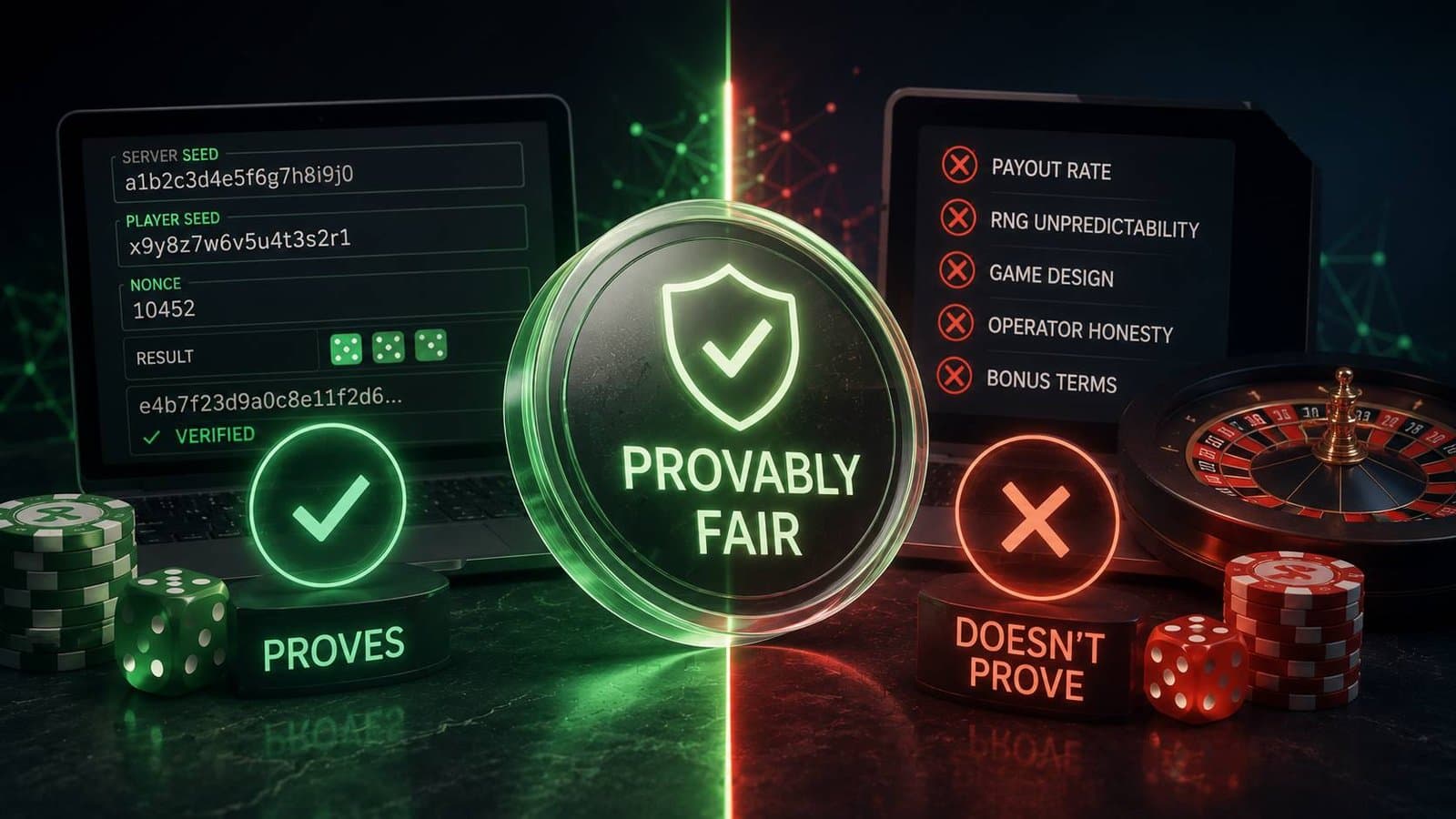
The term “provably fair” is often misinterpreted by players as a guarantee that games are fair. In reality, it serves a much narrower purpose. Instead of proving that games are beneficial for players, it confirms the integrity of a specific game outcome, allowing players to verify the results from a single game round.
At the core of a provably fair system is the combination of three elements: a server seed, a client seed, and a nonce. The casino publishes a hashed version of the server seed before a bet is placed, while players provide the client seed or generate it through their browser. The nonce increments with each new bet, ensuring that even identical seeds yield different results. When these components go through a hashing function, the game outcome is produced.
This setup guarantees that the casino cannot manipulate the server seed after seeing the wager. By requiring the player’s input for the client seed, the casino also prevents themselves from predicting the outcome. In essence, it proves that a specific game round was committed beforehand and remained tamper-free afterwards, something a traditional casino cannot assert.
Clarifying Misconceptions About Fairness
One major misconception is that provably fair games are inherently advantageous for players. This is false. Even if every round is verified as fair, the house edge remains intact, favoring the operator. Provably fair confirms that the results align with the programmed probabilities but does not guarantee that those probabilities are favorable to players. The house edge is built into the game and exists independently from the verification system.
Limitations of Provably Fair Systems
Provably fair mechanics are primarily applicable to the casino's in-house games, such as dice games, crash games, or variations like mines and plinko, where a singular algorithm determines the outcome. These games come with fairness panels and round verifications. In contrast, third-party slots and live dealer games depend on certified random number generation (RNG) processes, which are validated through external audits rather than player verification. Therefore, a casino claiming to be “provably fair” may only offer this assurance for their original titles; other games on the platform may not share the same level of verification.
Operator Trustworthiness Remains Unclear
Perhaps the most critical limitation of provably fair systems is that they do not validate the integrity of the casino itself. Just because a game round is proven to be tamper-free does not imply the operator is trustworthy or the casino is safe. Players must remain vigilant about the overall credibility of the platforms they engage with.
This material is informational and not intended as financial advice.