Over 107 Million POL Tokens Burned in 2026 — Why Is the Price Still Falling?
Polygon burned over 107 million POL tokens in 2026, turning net deflationary, yet its price continues to fall due to persistent technical weakness and selling pressure.
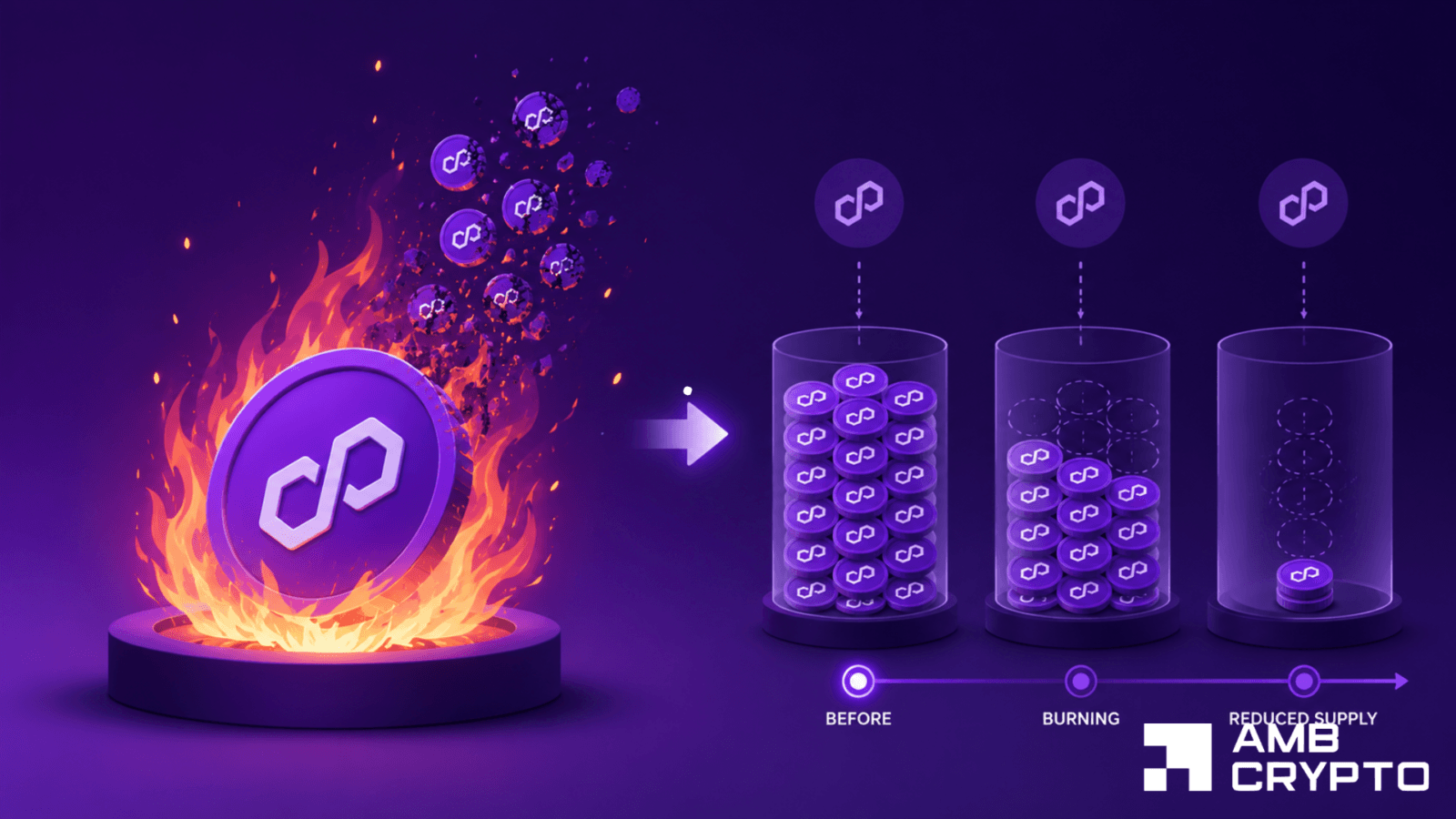
Polygon (POL) has established itself as one of the most actively used blockchain networks for payments, with transaction volumes rivaling or even exceeding those of major players like Solana (SOL). Yet despite a series of strong on-chain metrics, the token's market price continues to slide — leaving investors puzzled.
As of the latest data, POL is trading around $0.06948, having dropped more than 1% in the past 24 hours after losing support at the $0.07161 level. The decline stands in stark contrast to the network's underlying health indicators, which paint a far more optimistic picture.
Polygon's co-founder and CEO Sandeep Nailwal recently took to X to announce a notable milestone: the network has burned more than 107 million POL tokens so far in 2026, officially making it net deflationary for the year. This is particularly impressive considering that over 105 million new POL tokens were minted during the same period. The burned tokens originated from base fees collected on the network, resulting in a marginal but meaningful reduction in circulating supply.
This achievement sets Polygon apart from some of its biggest rivals. Networks like Ethereum (ETH), Solana, and Sui (SUI) have collectively introduced hundreds of millions of dollars' worth of newly issued tokens into the market during the same timeframe — expanding rather than contracting supply.
The surge in burned tokens is a direct result of heightened transaction activity. Polygon recorded the highest stablecoin payment volume in May across all payment-focused networks, hitting an impressive 198 million transactions. This places the network firmly among the top-tier infrastructure providers for real-world financial applications.
Large holders are also showing signs of confidence. One whale recently converted 17.512 million MATIC tokens into an equivalent amount of POL — valued at approximately $1.25 million — signaling continued belief in the project's long-term trajectory. Additionally, a multisig wallet connected to Stader Labs and Polygon staked 11 million POL tokens worth around $839,410. That same wallet now holds over 28 million POL in staking, a move that simultaneously reduces market-available supply and bolsters network security.
So why, with all these positives, is POL's price struggling?
The answer lies in technical market dynamics. Polygon has been caught in a sustained downtrend since late 2024. On the weekly chart, the token has been consolidating within a triangle pattern that is approaching a critical breakout point. Sellers have maintained strong dominance since October 2025, as evidenced by a persistently red Bull Bear Power indicator. The Cumulative Volume Delta (CVD) further confirms bearish pressure, with approximately 670,000 POL tokens being offloaded onto exchanges.
In essence, strong fundamentals have so far been unable to overcome the bearish technical structure gripping the asset. Until buying pressure returns and the price breaks decisively out of its triangle consolidation, POL may continue to underperform relative to its on-chain achievements.
The disconnect between Polygon's network growth and its token price is a reminder that fundamentals and market sentiment don't always move in lockstep — especially during prolonged bear phases.