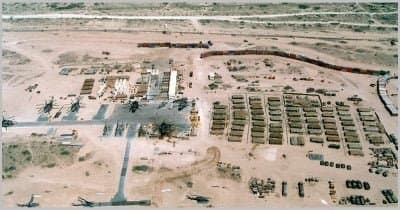
Prediction markets shifted sharply on July 23 after Iran's Revolutionary Guards claimed direct strikes on two U.S. military installations in Kuwait: Ali Al Salem Air Base and Al Adairi camp. The statement listed specific targets, including equipment depots, a Patriot air defense battery, drone facilities, and troop accommodation areas, and asserted that American personnel were killed or wounded.
What the Guards Said
The Revolutionary Guards' announcement named both sites by name, an unusual level of specificity in Iranian military communiques. The Patriot system is among the most visible symbols of U.S. air defense posture in the Gulf, and its inclusion in the target list signals the strike was framed as an attack on American force-projection capability, not just infrastructure. No independent confirmation from U.S. Central Command or Kuwaiti authorities had been issued at the time of publication.
Kuwait hosts thousands of U.S. troops and serves as a primary logistics hub for American operations across the region. Ali Al Salem, in particular, has functioned as a forward operating base for decades. Any confirmed damage there would represent a qualitative step beyond the drone and missile exchanges that have characterized recent Gulf escalations.
Market Read and What Follows
Prediction markets moved to price a higher probability of Iranian military action against Gulf states broadly, not just against U.S. forces. The specific scenario of Iranian ground forces crossing into Kuwait was attracting notable volume. That scenario, if confirmed, would draw in Gulf Cooperation Council responses and almost certainly trigger the mutual defense provisions underpinning U.S. basing agreements in the region.
Observers are watching for three things: official U.S. or Kuwaiti damage assessments, any Iranian follow-on strikes, and whether diplomatic back-channels in Doha or Muscat activate. The speed of those responses will determine whether this stays a claimed strike or becomes the opening move in a wider ground phase. The broader pattern of escalating physical-domain attacks documented across other sectors in 2026 adds context to how quickly localized incidents can compound.