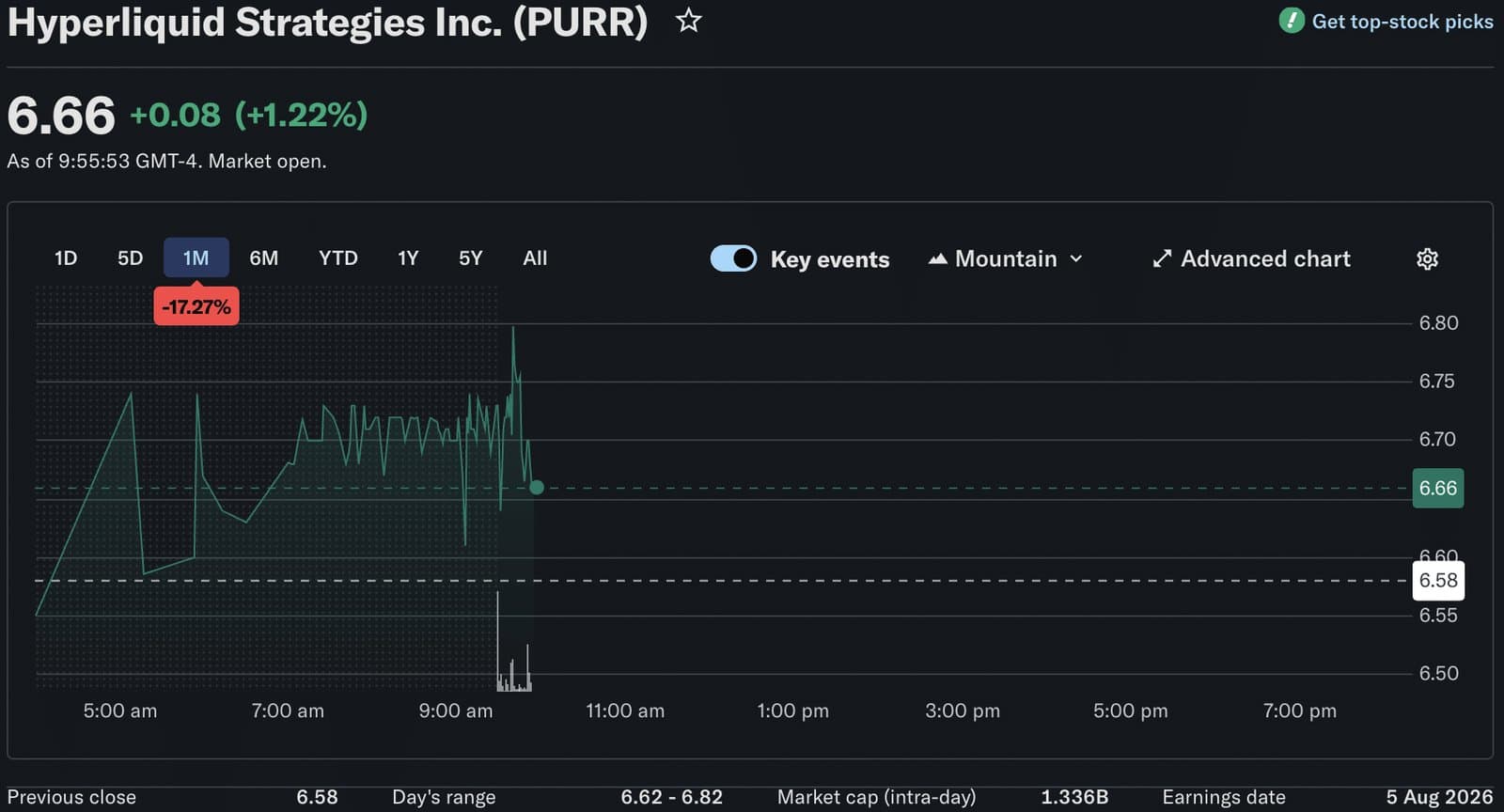
Hyperliquid Strategies, the fund managing HYPE's treasury, accumulated 11.12 million tokens worth over $100 million weekly. That's nearly 10% of the entire circulating supply, making it the single largest digital-asset treasury position in crypto by float percentage. The accumulation was relentless and mechanical. It worked.
HYPE rocketed higher on pure scarcity mechanics. The AQAv2 upgrade funneled stablecoin reserve yields straight into token buybacks, which meant the protocol was spending real revenue to manufacture artificial price momentum. Blockworks analyst Shaunda Devens watched the pattern unfold and saw exactly what it was: a bid divorced from fundamentals. No underlying business acceleration. No expanding protocol metrics. Just concentrated buying, decoupled from earnings power.
Then the buying stopped. Profit-taking followed.
The Revenue Picture Tells a Different Story
Hyperliquid's July 2026 revenue hit $43 million. A year earlier, in July 2025, it was $92 million. That's a 50% year-over-year collapse for a protocol that built its valuation narrative on dominating on-chain perpetuals trading. The gap between what the token price suggested and what the actual business was generating had become impossible to ignore. Traders took their cuts. HYPE now trades around $55, up a tepid 5% in 24 hours but crushed from its recent highs.
The uncomfortable reality is that many utility-backed projects have already fallen 90% or more from their peaks in this market. HYPE's decline, though sharp, reflects something simpler: a correction from a price that was never anchored to cash generation in the first place. The treasury bid created momentum. Momentum created illusion. Illusion faded.
HYPE trades at $55, up 5% in 24 hours.
This article is for informational purposes only and should not be construed as investment advice.