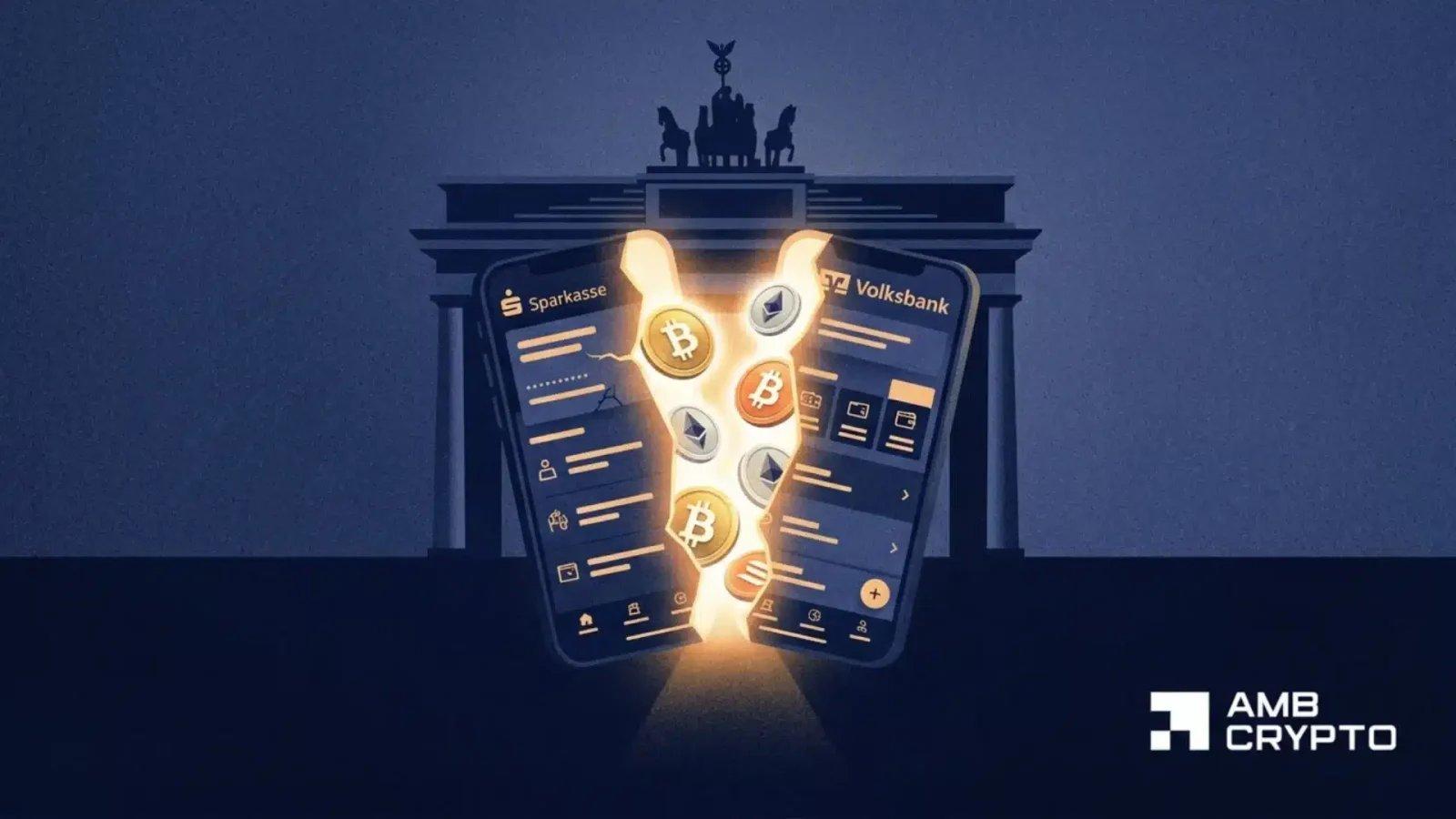
Germany’s leading banking networks, Sparkassen savings banks and Volksbanken Raiffeisenbanken, are incorporating cryptocurrency trading directly into their banking applications, a significant move for the financial sector.
This integration allows approximately 80 million clients across Germany to buy and sell digital assets without relying on external cryptocurrency exchanges. This marks one of the largest adoptions of cryptocurrency within traditional banking in Europe.
Historical Context and Regulatory Framework
The transition is particularly striking given that just four years prior, these banking institutions deemed cryptocurrencies as too risky. Currently, they are constructing their regulated cryptocurrency infrastructure independently, with no collaboration from outside exchanges.
As part of this initiative, the cooperative banks have launched the meinKrypto platform via DZ Bank, enabling local franchises to offer Bitcoin and Ethereum directly to retail customers. This platform, which received approval from Germany’s financial regulator BaFin in December 2025, operates under the European Union’s Markets in Crypto-Assets (MiCA) framework. meinKrypto officially became operational following the announcement on January 14.
Crypto Custody and Upcoming Services
Additionally, Boerse Stuttgart Digital is providing crypto custody services, ensuring that asset storage and trading comply with German regulations. DekaBank is also set to introduce a similar service for Germany’s savings banks in the near future.
Challenges and Criticism
Despite these advancements, the initiative has faced criticism. Research indicates that only a small percentage of German cryptocurrency owners trust their primary banks more than independent cryptocurrency platforms. Co-Pierre Georg, a professor at the Frankfurt School of Finance & Management, expressed concern that inexperienced customers might misjudge the volatility and risks associated with cryptocurrencies, attributing these risks to the endorsement by established banks.
Moreover, German cryptocurrency retail volume statistics reveal a decline. The first quarter of 2026 exhibited a 20% year-over-year drop, with retail volume decreasing from $31.7 billion in Q1 2025 to $25.3 billion in Q1 2026, according to TRM Labs.
This combination of increased accessibility to cryptocurrency trading through conventional banks and the warnings over potential risks marks a pivotal moment for Germany's financial landscape.