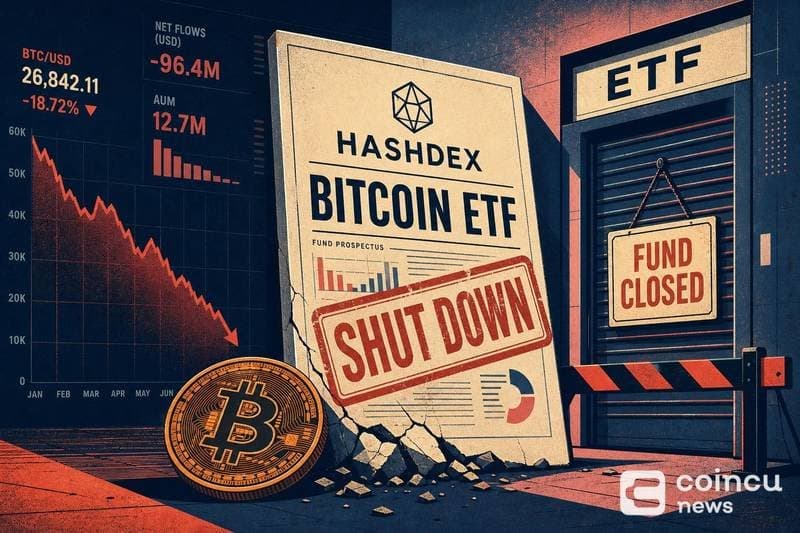
Hashdex is liquidating its Bitcoin ETF, shutting down a fund that never managed to break $15 million in assets despite launching into one of crypto's biggest waves. The fund, trading under ticker DEFI on NYSE Arca, will stop trading August 17, 2026, with cash returned to investors shortly after, according to an SEC filing dated August 3, 2026.
This marks the first known collapse of a U.S. spot Bitcoin ETF since the category exploded onto the market in early 2024. That launch was supposed to change everything. Regulators approved these products with enormous fanfare. Institutions were supposed to flood in. Instead, Hashdex's fund languished with just $14.48 million in assets, dwarfed by competitors who managed to gather billions in the same window.
How a Bitcoin ETF ends up this small
DEFI shifted to holding actual spot Bitcoin in March 2024, abandoning its earlier futures-based strategy. The timing should have been perfect. The whole market was moving toward spot products. Yet the fund never gained traction. Hashdex's decision to wind down appears voluntary, not forced by regulators. The company filed a prospectus supplement under SEC Rule 424(b)(3), the standard disclosure when an issuer chooses to dissolve.
The fund faced brutal competition. When spot Bitcoin ETFs launched in January 2024, every major player wanted a piece. Some attracted institutional money at scale. Others built brand recognition through existing distribution networks. Hashdex had neither advantage. Without significant assets under management, the fund couldn't cover operating costs or justify its existence to shareholders.
What this says about the ETF market
One collapse doesn't break the category. BlackRock, Fidelity, and other heavyweights continue raking in hundreds of millions. But Hashdex's shutdown signals something real: not every player survives in crypto finance, even when regulators open the door. Size matters enormously. A $14 million fund can't compete on fees or liquidity with competitors managing 50 times that capital.
This also shows that the initial ETF boom has settled into a consolidation phase. The early excitement has given way to a winner-take-most dynamic. Smaller operators and late entrants struggle to differentiate when the largest firms offer nearly identical products with better infrastructure and cheaper fees.
This article is for informational purposes only and should not be considered financial advice or an investment recommendation.