Coldcard Q's Key Teleport: A Year In — Redefining Secure Bitcoin Key Management for Treasuries
Imagine you're traveling abroad, a critical payment needs to be made from your company's Bitcoin treasury, and your hardware wallet is sitting on a desk thousands of miles away. This scenario — once a nightmare for Bitcoin key holders — is exactly what Coinkite's Key Teleport feature was designed to solve. Now a full year after its release, it's worth taking a hard look at how this technology actually performs in practice.
Key Teleport is an exclusive feature of the Coldcard Q, Coinkite's flagship premium Bitcoin hardware wallet. It represents what may currently be the most secure method available for transmitting key material remotely — and understanding why requires stepping back to consider what the alternatives looked like before it existed.
Prior to Key Teleport, anyone serious about securely transmitting a private key over the internet would have avoided consumer messaging apps entirely. Apps like WhatsApp or Signal, despite their end-to-end encryption branding, run on top of extraordinarily complex operating systems and hardware — hardware that often contains deeply embedded firmware from manufacturers with questionable privacy track records. Smartphones simply were not engineered to safeguard high-value cryptographic secrets tied to irreversible financial transactions.
The gold standard for paranoid key transmission previously involved booting Tails OS — a lean, privacy-hardened Linux distribution — on a known-clean device, ideally a dedicated burner laptop. The sender would generate a fresh PGP key pair, the recipient would do the same, and an asymmetrically encrypted message would be crafted and transmitted over Tor, often layered beneath an additional VPN. This is, in fact, the method Edward Snowden used when initially contacting journalist Glenn Greenwald to pass along the 2014 NSA surveillance disclosures. It works. It is also, without question, an exhausting operational undertaking.
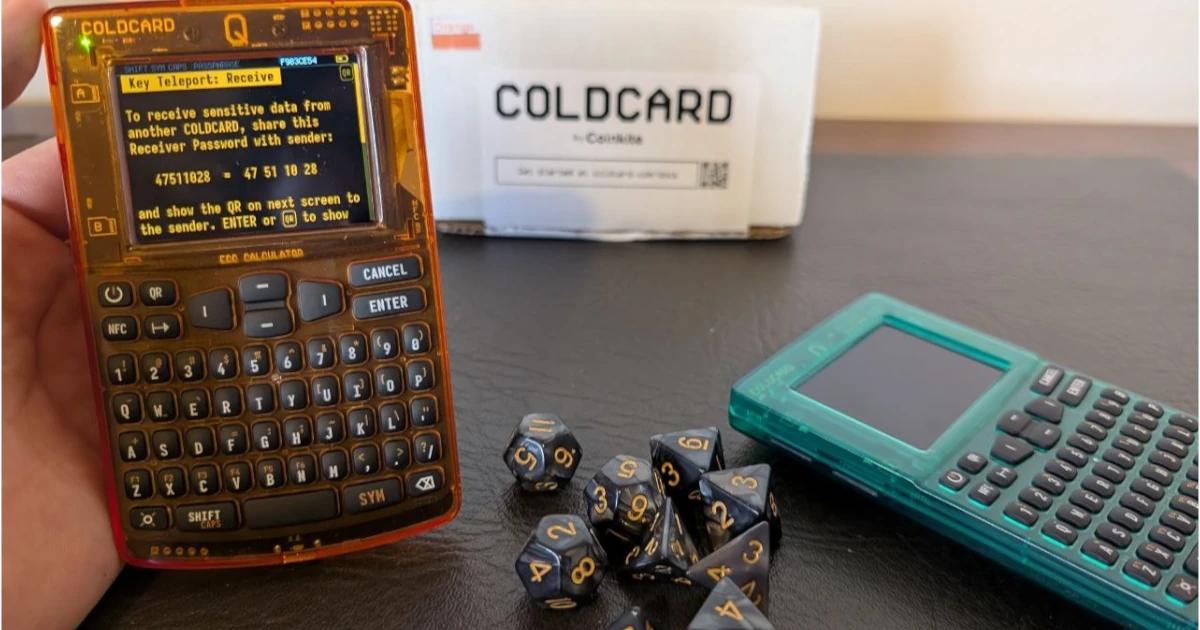
Key Teleport condenses that entire workflow into a process that runs natively on the Coldcard Q's secure hardware, removing the attack surface introduced by general-purpose computers and their software ecosystems. With Key Teleport, users can transmit encrypted messages across the internet without relying on the security of any external device. Practical applications include sending a partially signed multisig Bitcoin transaction to a remote co-signer, or transmitting a fully encrypted wallet backup — complete with metadata, key material, and custom configuration — to a specific recipient device.
For this review, two Coldcard Q units were obtained to test the feature directly. The encrypted output produced by the device proved resistant to analysis even with advanced AI-assisted attempts to interpret it.
On the hardware side, the Coldcard Q — now available in multiple case colors — is purpose-built for airgapped communication. It carries forward the dual secure element architecture introduced in the Mk4 series: two closed-source chips from separate manufacturers working alongside an open-source microcontroller to handle key generation, encryption, decryption, and sensitive data storage. Compromising the wallet would require an attacker with physical access to successfully breach multiple independent components simultaneously. These secure elements directly underpin Key Teleport's cryptographic operations.
The device features a 3.2-inch LCD display with sufficient resolution to render BBQr codes — a QR standard developed by Coinkite that carries larger data payloads than conventional QR codes, requires no third-party libraries, and remains backwards compatible with standard readers. A dedicated QR scanner with a red strobe targeting indicator and an activatable flash assists in low-light conditions, addressing the common frustrations of variable screen quality and camera resolution that plague QR-based payments.
Cryptographically, Key Teleport employs a multi-layered protocol. Each transmission generates a single-use ephemeral key pair using the secp256k1 elliptic curve. The receiver's public key is encrypted with an eight-digit PIN via AES-256, ensuring that intercepted data cannot be decrypted without both the cryptographic material and the PIN shared separately through a secondary channel.
For Bitcoin treasury managers, multisig participants, and anyone who has ever found themselves holding keys in the wrong location at the wrong time, Key Teleport represents a meaningful leap forward — delivering the kind of operational security previously reserved for intelligence community workflows, packaged into a device that fits in a jacket pocket.