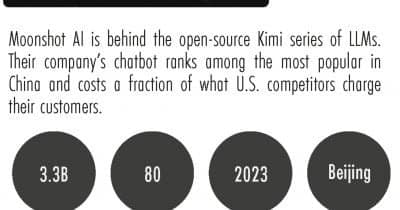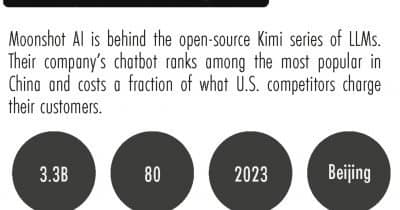
Moonshot AI from Beijing recently introduced its Kimi K3, claiming it as the world’s largest open-weight AI model with 2.8 trillion parameters. The launch has surprised AI experts and stirred concerns about the efficiency of Silicon Valley’s massive AI investments.
Kimi K3 was presented on July 16-17, 2026. The model’s parameter count marks a significant leap in scale, giving it a capacity to detect and process complex information. This size led to evaluations where it outperformed OpenAI's GPT-5.6 in some tasks, while falling just behind Anthropic's Claude Fable 5 overall. It excelled notably in front-end coding tasks, attracting enterprise interest.
Pricing and Open Access
Moonshot has outlined an accessible pricing model for Kimi K3’s API: $3 per million input tokens and $15 for output tokens. The model handles up to 1 million tokens in one context window, allowing it to analyze and maintain context over extremely long documents or conversations, such as entire books, without losing earlier details.
The company plans to open-source Kimi K3 by late July 2026, enabling developers and companies worldwide to use and adapt the model without paying license fees.
Market Impact and Strategic Position
This release echoes the disruption caused by China’s earlier DeepSeek AI, which also challenged US AI-related semiconductor valuations due to its competitive performance at a lower development cost. Following the Kimi K3 announcement, semiconductor stocks experienced a downturn as investors questioned the returns on large US AI infrastructure expenditures.
Moonshot focuses on efficient use of resources amid chip limitations, a factor seen as particularly unnerving by US companies heavily invested in AI development.
Company Background and Adoption
Moonshot’s founder, Yang Zhilin, established the company with a strong research orientation. Previous iterations of the Kimi model, such as K2.5 and K2.6, have gained traction with US firms including Cursor and DoorDash. The jump to 2.8 trillion parameters with K3 represents a major scaling effort, paired with a strategy to make the technology widely accessible through open-source licensing.
This material is for informational purposes only and does not constitute financial advice.