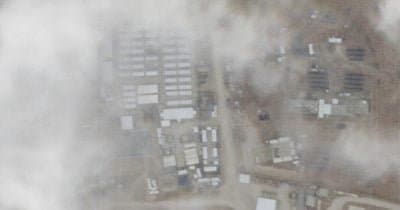
A military analyst commented, "China's replica enhances PLA's targeting precision for advanced missile systems." Recent satellite data reveals China has built a full-size mock-up of a US Navy Arleigh Burke-class guided-missile destroyer in the Taklamakan Desert, Xinjiang. The replica is equipped with simulated radar components, used to refine anti-ship missile targeting and improve AI-guided weaponry accuracy.
This installation aligns with China’s anti-access and area-denial strategy aimed at deterring US military intervention, especially regarding Taiwan. Experts note such developments signal increased Chinese military readiness and assertiveness in contested maritime zones, including the South China Sea, impacting regional players like the Philippines.
Financial markets have reacted by adjusting risk assessments: the chance of military conflict between China and Japan before 2027 is currently priced at 7.5%, while the likelihood of a clash involving the Philippines has risen to 11%. Observers expect further military drills or infrastructure expansions by the PLA in this region to influence these probabilities. Diplomatic shifts among China, Japan, and the Philippines will also be closely monitored.
These moves come amid broader tensions in the Asia-Pacific, with increased focus on strategic capabilities. For context on regional military activities, see US deployments to the Middle East here. The missile testing initiative using the replica shows China's commitment to enhancing its hypersonic and anti-ship missile systems.
This article is for informational purposes and does not constitute financial advice.