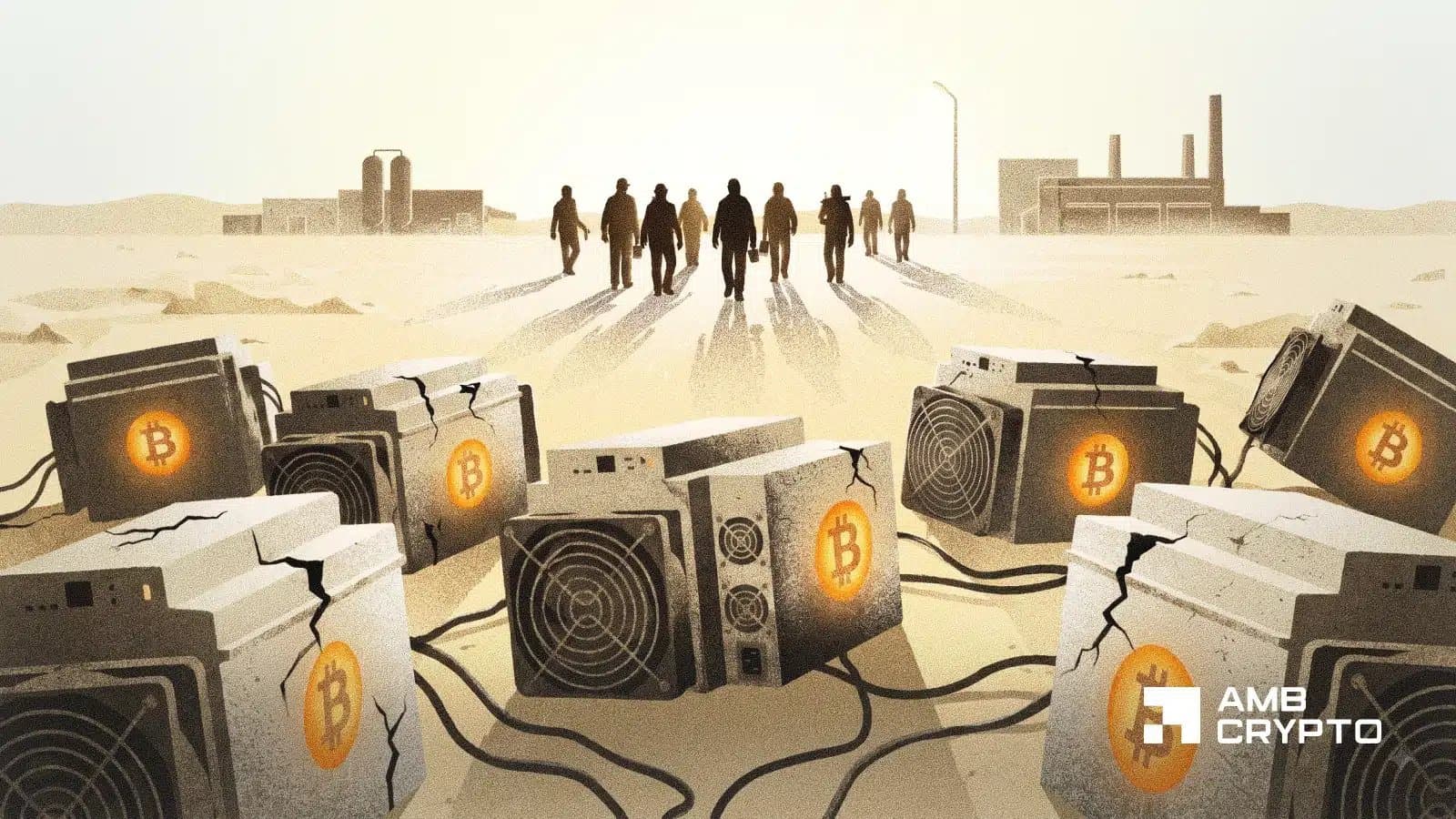
Bitcoin miners are quietly walking away. Not from crypto entirely, but from the asset that made them. For the first time in years, the economics of mining BTC have flipped so hard that even established operations are chasing artificial intelligence instead, leaving the network thinner and more vulnerable than it's been since 2019.
Daily miner revenue has collapsed to $30 million. That's a staggering drop from the $95 million peak in 2024 and roughly half the $60 million miners were pulling in mid-2025. Block rewards keep shrinking with each halving cycle, and transaction fees, which were supposed to fill the gap, have instead fallen to 7-year lows. Meanwhile Bitcoin's price has been cut in half, from $126K to $64.7K.
The math is brutal for smaller operators. Mining costs average $70.5K per coin, yet the market price sits below $65K. You're losing money on every block you validate. Larger miners with cheaper electricity can survive, but the margin is razor thin.
When miners become unprofitable, they disappear
This isn't a temporary squeeze. The current mining distress has dragged on for 250 days. That's roughly 3x longer than the 2022 bear market lasted or the 2018 downturn. Charles Edwards, founder of Capriole Investments, has watched this pattern closely. He notes that every major public Bitcoin miner is now diversifying into AI infrastructure, mining data, or computing contracts. The economics are simply better on the other side.
When hash rate drops, the network becomes easier to attack. A 51% attack, where someone controls the majority of mining power, becomes theoretically more feasible. That's not academic risk. It's the foundation of Bitcoin's security model cracking under financial pressure.
The deeper problem nobody wants to admit
Marathon Digital CEO Fred Thiel has been more blunt about this than most. He's called low transaction fee revenue Bitcoin's "fundamental challenge," pointing out that the network failed to become a usable payment system. Without that adoption, there's no organic fee market to sustain miners once block rewards disappear entirely.
Bear markets typically trigger these kinds of capital flight, and historically Bitcoin has recovered. But the shift this time feels structural. Miners aren't just waiting for prices to recover. They're building new revenue streams because they've realized Bitcoin alone can't support them long term. AI infrastructure pays better, requires similar hardware, and doesn't depend on a single asset's price action.
The irony cuts deep. Bitcoin was designed to be secure through decentralized mining, yet that security now hinges on whether mining remains profitable enough to compete with other uses of the same hardware.
This article is for informational purposes only and should not be construed as financial advice. Mining economics and network security are technical topics with real financial implications. Do your own research before making any investment or operational decisions.